
Most people manage their health by watching the wrong number. They track weight. They track resting heart rate. They wait for blood pressure to become a problem before they do anything about it. None of those are the strongest predictor of how long you live. VO2 max is. VO2 max longevity testing, reading how much oxygen your body can actually use under real load, has outperformed smoking status, diabetes, and coronary artery disease as a predictor of all-cause mortality in the largest study ever run on the subject. If you want one honest number about your future, this is the one.
That study is not a fitness-magazine claim. It came out of a hospital, ran for 23 years, and tracked over 122,000 real patients. We'll get to it. First, the mechanism.
Cardiorespiratory fitness is dose-dependent with no ceiling. The fitter you get, the lower your risk drops, all the way to the top of the fitness scale. There is no point where more fitness stops helping you.
What VO2 max actually measures
VO2 max is the maximum volume of oxygen your body can absorb and use per minute during hard exercise, expressed in milliliters per kilogram of body weight per minute. It is not a lung score or a heart score in isolation. It's a systems number: your lungs pulling in air, your heart pumping blood to working muscle, and your muscles pulling oxygen out of that blood and using it to make energy, all measured at once, under load. Cleveland Clinic describes it plainly: it's a good indicator of overall fitness and health because it reflects how well every link in that chain is working together, not just one organ.
That's why it predicts more than a treadmill time. A weak VO2 max means somewhere in that chain, the system is underbuilt. A strong one means the whole engine is doing its job.
VO2 max longevity testing: what the research actually shows
In 2018, Cleveland Clinic published a cohort study in JAMA Network Open that followed 122,007 adults who underwent exercise treadmill testing between 1991 and 2014, representing more than a million person-years of data. The findings, later summarized by Cleveland Clinic's own research team, were direct: cardiorespiratory fitness was inversely associated with long-term, all-cause mortality, with no observed upper limit of benefit. Patients in the "elite" fitness group had roughly an 80 percent lower risk of death than the least fit group, and each one-MET increase in fitness, about a 3.5 mL/kg/min gain in VO2 max, tracked with a 13 to 15 percent drop in mortality risk.
A separate review in the peer-reviewed literature reached the same conclusion from a different angle, describing VO2 max as one of the strongest single predictors of longevity ever identified, ahead of most traditional risk factors doctors already screen for. See the review on PubMed. That's the case for VO2 max longevity testing in one sentence: it doesn't just correlate with a longer life, it out-predicts the risk factors most people already worry about.
What a real test involves
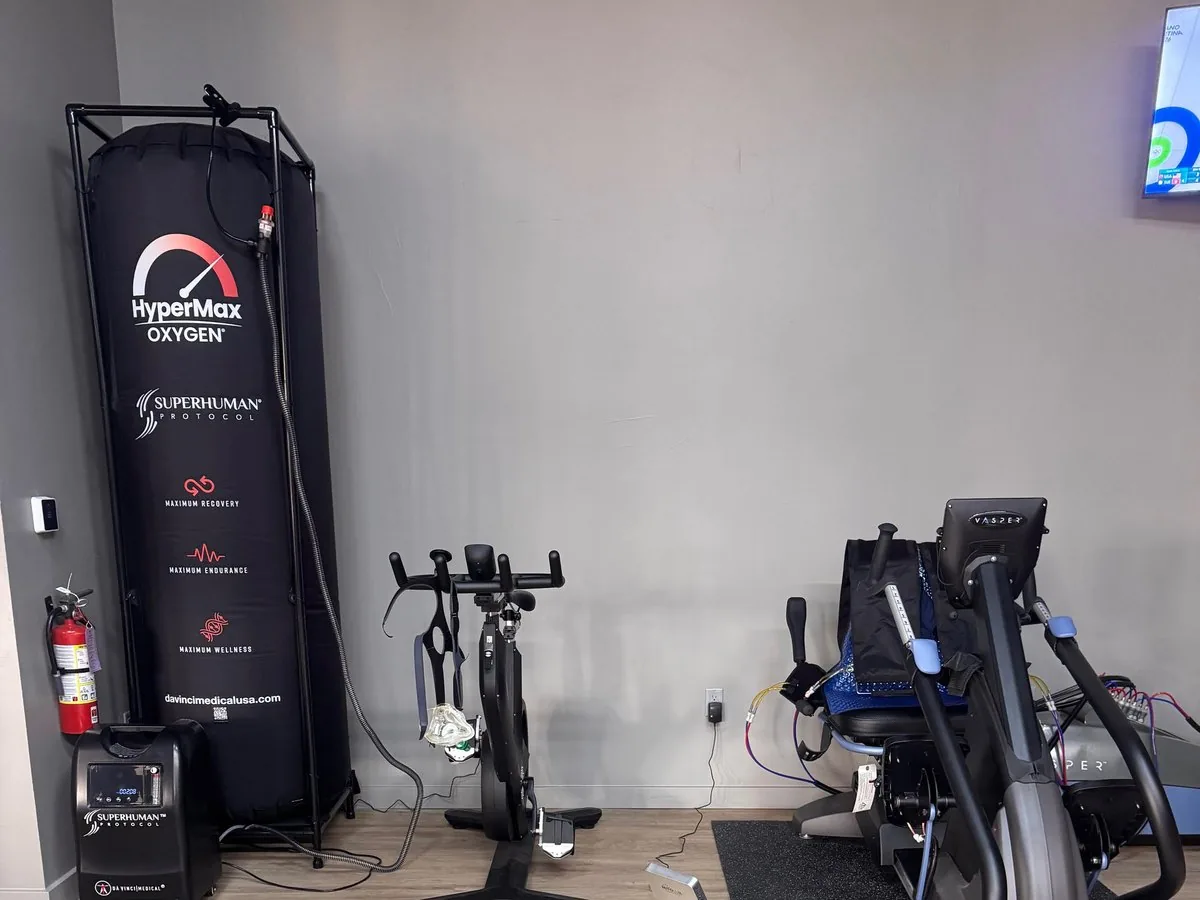
Most VO2 max numbers you'll find online are estimates, back-calculated from your age, resting heart rate, or a submaximal step test. An estimate is a guess wearing a decimal point. A real test is measured, not estimated, using a metabolic cart, which is why WLF Club has one on site in Fort Worth: a PNOE metabolic cart that reads your actual gas exchange, breath by breath, while you work.
Here's what that session actually involves:
- A calibrated mask that measures the oxygen you inhale and the carbon dioxide you exhale, breath by breath, while you work progressively harder on a bike or treadmill
- Your true VO2 max number, measured directly from gas exchange, not an age-based formula estimate
- Ventilatory threshold data: the exact intensity where your body shifts from burning mostly fat to burning mostly carbohydrate
- A metabolic efficiency reading, showing how well your body actually uses oxygen at a given pace or wattage
- A baseline number you can retest against later, so progress gets measured instead of guessed at
What we do with the number
A number by itself doesn't change anything. This is where the read matters more than the test. A VO2 max test isn't the finish line here, it's the input. We would rather tell you no than sell you the wrong plan, so we read you first and build from what the data actually shows, not from a generic template.
Your VO2 max result feeds directly into two of the six pillars WLF reads before recommending anything: Performance & Fitness, and Metabolic & Nutrition. If your number is strong, the plan is built to protect and raise your ceiling. If it's flagging early decline, the plan is built to close that gap before it becomes a bigger problem. Either way, you leave with a specific next step tied to your own physiology, not a membership pitch built for someone else's body. That work continues through our Medical programming, where testing data like this actually gets used, not just filed.
Who this is for
If you're an athlete, VO2 max is your ceiling. It tells you how much aerobic engine you have to work with before technique and strength even enter the conversation, and it's one of the clearest ways to measure whether your training and recovery are actually paying off. Our Performance programming uses that number to set real targets instead of guessing at volume.
If you're 45 or older, this isn't about training for a race. It's about capability. VO2 max is one of the clearest early signals of the decline that eventually shows up as breathlessness on stairs, fatigue by mid-afternoon, or a shrinking radius of what you can do for the people who count on you. Catching that trend early, while there's still runway to change it, is the entire point of testing before symptoms force the issue.
Frequently asked questions
QWhat is considered a good VO2 max?
Good VO2 max ranges shift by age and sex, and they're best read against your own normative bracket rather than a single number everyone should hit. A measured test gives you your actual figure against those norms, which is more useful than comparing yourself to a stranger's number online.
QHow is VO2 max tested?
The gold-standard method uses a metabolic cart: you wear a mask that measures the oxygen and carbon dioxide in every breath while working at increasing intensity on a bike or treadmill until you reach your true maximum effort. That's a directly measured number, not the age-formula estimate most wearables produce.
QCan VO2 max be improved?
Structured aerobic training, particularly work near your ventilatory threshold, is designed to support meaningful gains in VO2 max over time for most people. How much room you have to improve depends on your starting point, age, and training history, which is exactly what a baseline test and a retest are for.
QIs VO2 max testing only for athletes?
No. The research behind VO2 max longevity testing was run on a general patient population, not an elite athlete cohort, which is exactly why it matters for everyday health and not just performance.
QHow often should I retest my VO2 max?
It depends on your goal and your starting point. A baseline test followed by a retest after a defined training block is the most useful pattern, since it turns the number into a trend instead of a one-time snapshot.
QDoes WLF Club test VO2 max in Fort Worth?
Yes. Testing runs on a PNOE metabolic cart at our location, with the results read against the six pillars WLF tracks before anything gets recommended, rather than handed to you as a number with no plan attached.
This article is for education, not medical advice, and it isn't a promise of a specific result. Talk with a qualified provider about your situation before changing your training or health plan.
Sources: JAMA Network Open (Mandsager et al., 2018) · Cleveland Clinic · Cleveland Clinic Consult QD · PubMed. Every citation links to the original source above.